Losing a tooth, whether to decay, injury or gum disease, can change how you chew, speak and smile. The good news is that you have solid options for replacing it. The two most common are a dental bridge and a dental implant. Both fill the gap, but they work in very different ways, and the right choice depends on your oral health, your budget and your long-term goals. This guide explains how each one works so you can walk into your consultation with confidence.
What Is a Dental Bridge?
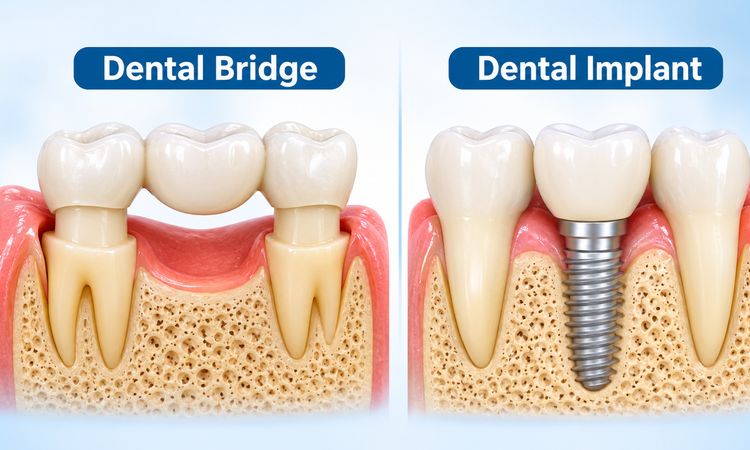
A dental bridge does exactly what the name suggests: it bridges the space left by a missing tooth. A false tooth, called a poetic, is joined to dental crowns placed on the teeth on either side of the gap. Those neighboring teeth act as anchors that hold the whole structure in place.
The main appeal is speed. Treatment usually takes just a few weeks and does not require surgery. The trade-off is that healthy adjacent teeth must be reshaped so the crowns fit over them. Our team explains the full process on our dental bridges.
What Is a Dental Implant?
A dental implant replaces the tooth from the root up. A small titanium post is placed in the jawbone, where it gradually fuses with the bone over several months. Once it has healed, a custom crown is attached on top. The result looks, feels and functions much like a natural tooth.
Because the implant stands on its own, neighboring teeth stay untouched. Because it sits in the bone, it also helps keep the jaw stimulated, which matters for long-term facial structure. If you want a detailed walkthrough, read our guide to dental implants in Arlington: cost, process and what to expect.
Dental Bridge vs Dental Implant: The Key Differences
Here is how the two treatments compare in the areas patients ask about most:
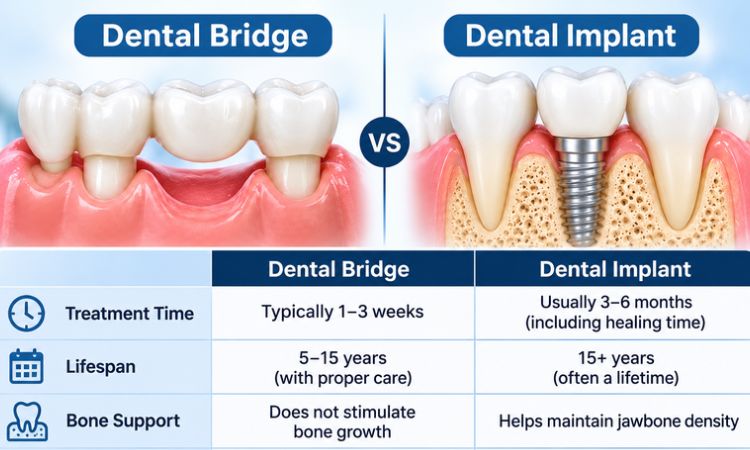
- Treatment time: A bridge is typically completed in a few weeks. An implant takes longer because the bone needs months to heal around the post.
- Impact on nearby teeth: A bridge requires reshaping the teeth beside the gap. An implant leaves them alone.
- Bone health: After a tooth is lost, the bone beneath the gap can slowly shrink. An implant provides root-like support that helps slow this process, while a bridge does not.
- Longevity: Bridges commonly last somewhere between 5 and 15 years. Implants can last decades with good care, and the crown on top may need replacing at some point.
- Cleaning: Bridges need special floss or traders to clean underneath. Implants are brushed and flossed much like natural teeth.
- Upfront cost: Bridges generally cost less at the start. Implants cost more initially but may prove more economical over the long run.
Which Option Is Better for You?
There is no single winner, because the better option is the one that suits your mouth. Still, some situations point in a clear direction.
A dental implant is often the stronger choice when:
- The neighbouring teeth are healthy and you want to keep them untouched.
- You have enough healthy jawbone, or are open to preparing the area first.
- You want the most durable, natural-feeling replacement.
- You are replacing a tooth in a younger patient, where a long-term solution matters most.
A dental bridge may make more sense when:
- The teeth beside the gap already have large fillings or crowns and could use the extra support.
- You prefer to avoid surgery or have a medical condition that makes it risky.
- You need a faster solution with a lower upfront cost.
- Bone loss makes implant placement more complicated.
If several teeth are missing, other solutions such as dentures or multiple implants may be worth discussing. For a broader overview before you decide, our article on what to know before replacing missing teeth is a helpful starting point.
What About Cost and Insurance?
Price varies with the number of teeth involved, the materials used and whether any preparation, such as an extraction or bone support, is needed. Many dental plans cover part of a bridge, and some offer partial coverage for implants, so it is worth checking your benefits before you commit. At Cosmo Smiles Dental, we review your options and costs with you during your visit, so there are no surprises later.
Planning Your Treatment at Cosmo Smiles Dental
Every treatment starts with a thorough exam, so Dr. Kaur can assess your gums, the neighboring teeth and your bone health. If the damaged tooth still needs to come out, we can talk through tooth removal and how it fits into your plan. We also use CAD/CAM technology to create same-day crowns for suitable cases. If implants interest you, you can learn more about our dental implants in Arlington, VA.
Frequently Asked Questions
1. Is a dental bridge or an implant better for a missing tooth?
Implants are often preferred for long-term durability and for protecting neighbouring teeth and jawbone. Bridges are a quicker, non-surgical option with a lower upfront cost. The best choice depends on your oral health, so an exam is the only way to know for sure.
2. How long does a dental bridge last compared to an implant?
A bridge often lasts about 5 to 15 years with proper care. An implant can last for decades, although the crown attached to it may eventually need replacement.
3. Does getting a dental implant hurt?
Implant placement is done with local anesthesia, so you should not feel pain during the procedure. Mild soreness and swelling afterward are normal and usually manageable with the aftercare instructions we provide.
4. Can you get a bridge if you do not have teeth on both sides of the gap?
A traditional bridge needs a tooth on each side for support. If those anchor teeth are missing or too weak, an implant is usually the more practical solution.
5. Is a dental implant cheaper than a bridge in the long run?
Implants cost more at the start, but because they tend to last longer and do not rely on neighbouring teeth, many patients find them more cost-effective over time. Your own results will depend on your care and oral health.
Ready to Replace You’re Missing Tooth?
Choosing between a dental bridge and a dental implant is easier when you have a clear understanding of your oral health. Our team at Cosmo Smiles Dental in Arlington will walk you through both options, answer your questions, and help you choose the one that best fits your dental needs, lifestyle, schedule, and budget.
Contact Cosmo Smiles Dental today or call (571) 210-4747 to schedule your consultation.
